Short answer: Blackbeard was killed in shallow water off the southwest side of Ocracoke Island on November 22, 1718, at an anchorage still called Teach's Hole. He went down at close quarters: five gunshots, about twenty blade wounds, and a broadsword to the neck to finish it. You can look out over the spot today from Springer's Point Preserve. There's no marker on the water — there's nothing to mark.
The name is older than the legend. An anchorage here was lettered "Thatches Hole" on a colonial chart of the inlet in 1733, fifteen years after he was killed, and it has stayed on the maps ever since. The case file lays out the sheets.
The fight
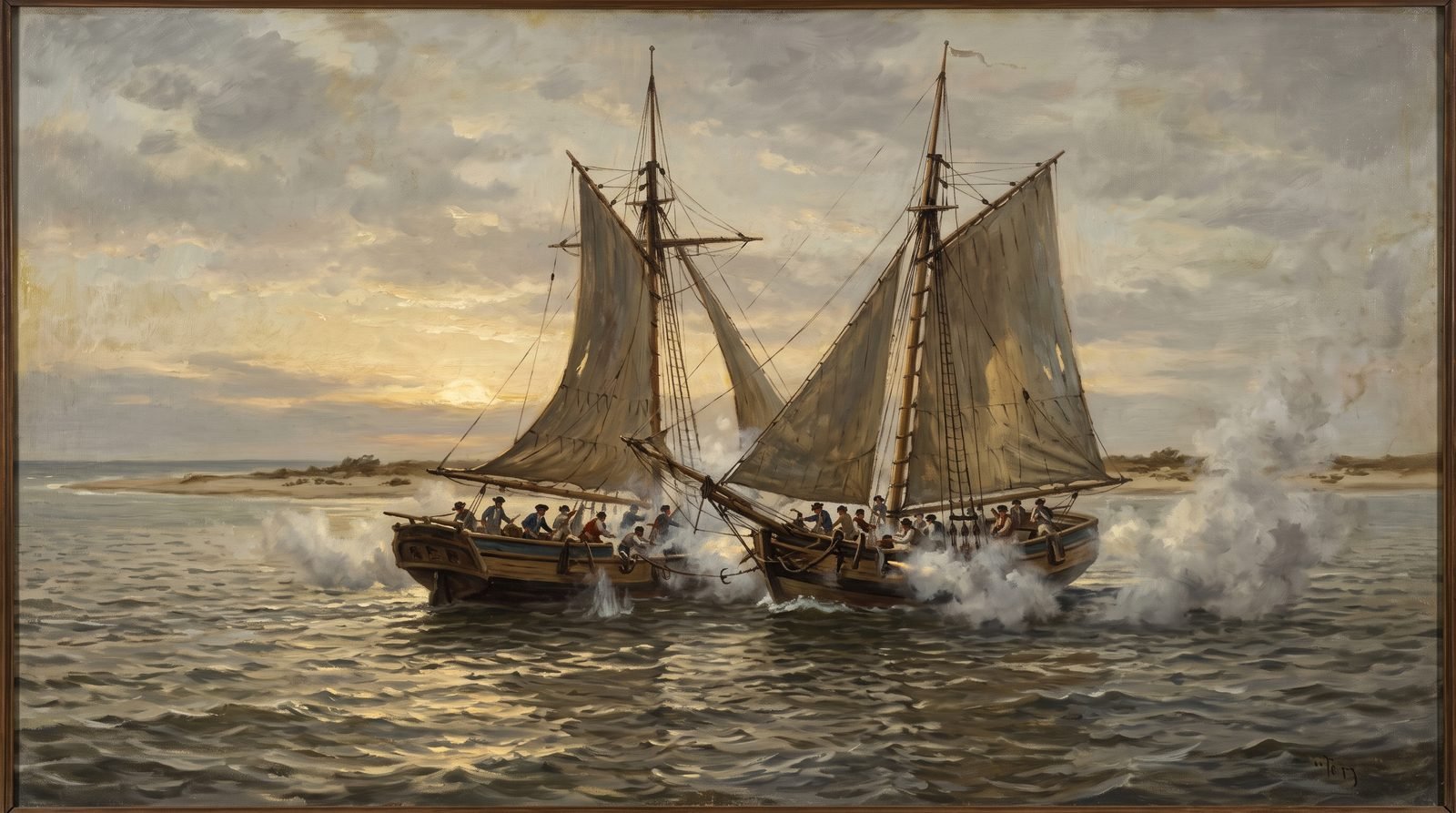
Lieutenant Robert Maynard came for him with two chartered civilian sloops, Jane and Ranger — small craft, shallow enough to work the inlet where a warship couldn't. Maynard took command of the Jane.
It ended at close quarters and it did not end quickly. Contemporary accounts have Blackbeard taking five gunshots and around twenty blade wounds before he went down.
The killing blow came from a Highlander in Maynard's crew, and the Boston News-Letter printed the exchange:
"…being a Highlander, ingaged Teach with his broad Sword, who gave Teach a cut on the Neck, Teach saying well done Lad, the Highlander reply'd, if it be not done well, I'll do it better, with that he gave him a second stroke, which cut off his head."
His head was hung from the bowsprit. His body went over the side. Local legend has it swimming three times around the ship before it sank, which is a very good story and nothing more than that.
What happened to his head, and where he's buried
Maynard sailed back to Virginia with the head still hanging from his sloop's bowsprit. There it was set on a pole at the mouth of the Hampton River, a warning to anyone else thinking about the trade. The spot is still called Blackbeard's Point, in Hampton.
Nobody wrote down when it came off the pole. The story that picks up after that is a silver-plated skull cup the writer Edward Rowe Snow said he found on the mantel of a Virginia pub. It sits in storage at the Peabody Essex Museum in Salem, Massachusetts, and the museum says it can't be proven to be his.
There is no grave. His body went into the inlet, and no burial place for Blackbeard has ever been identified, on Ocracoke or anywhere else. Two men really are buried out at Springer's Point. Neither of them is him.
What they found
In 1996, a private research firm located a wreck off Beaufort Inlet believed to be the Queen Anne's Revenge — Blackbeard's flagship, run aground in June 1718. Archaeologists have been recovering material from the seabed ever since: cannon, ballast, shot, gold dust, hundreds of thousands of individual artifacts. The North Carolina Maritime Museum in Beaufort holds them.
The ship was never raised. It was documented and picked over, piece by piece, for decades.
What they didn't
No hoard. Not there, not anywhere. Three hundred years of digging on this coast has produced no Blackbeard treasure, and the sites people keep returning to fall apart when you look at them:
- Plum Point, Bath. He took the King's pardon and kept a house in Bath — North Carolina's first town, founded 1705 — near enough to Governor Eden to be neighborly. All that's left is a foundation people argue about.
- Teach's Kettle. A brick structure near Bath, said to be his, said to be full of gold. Almost certainly a kettle for boiling wood tar, which is what everyone on that coast was doing. A landowner eventually demolished it out of sheer irritation at people digging around it.
- Archbell Point. Governor Eden's estate, with a legend about secret passages for delivering the Governor's share. Nothing has ever come out of it.
The full accounting — what was recovered, what never was, and the open question of whether a chest was ever buried at all — is on the treasure page.
His own account
The night before Maynard arrived, his crew asked whether his wife knew where the money was hidden. Captain Charles Johnson's A General History of the Pyrates, published in 1724, records the answer:
"…that no-body but himself and the Devil, knew where it was, and the longest liver should take all."
Three hundred years on, that has held up better than anything else he said.
Kildare Island doesn't exist. Ocracoke does.
The series is filmed in South Carolina, and its island is invented. This one isn't. The man was real, the water where he died is real, and the gold nobody has found is the same gold this island still argues about. The hunt is how you walk that ground.
His name on the island today
Three centuries on, Blackbeard is still the island's biggest export. Most of what carries his name is a gift shop's idea of him — but a few places are worth knowing about, and one that every travel site still recommends has been shut for years.
- Springer's Point. A 132-acre maritime forest preserve at the south end of the village, and the one stop that is genuinely about him. Local tradition calls this ground Teach's Plantation, though no deed is known to use the name. The path ends on a sound-front beach looking out over Teach's Hole, the water he died in. Free and about a fifteen-minute walk from Silver Lake, but check the hours: foot access only, 8am to sunset, closed Mondays.
- Blackbeard's Lodge. Built in 1936 as the Wahab Village Hotel, and still the oldest operating lodging on Ocracoke by more than twenty years. The name is marketing rather than history — it has no connection to the man — but the building itself is a real piece of the island's story.
- 1718 Brewing. A brewery and restaurant on Silver Lake named for the year he was killed. The best-named business on the island, and the year is correct.
- The Ocracoke Lighthouse. Not a Blackbeard site at all — it was first lit in 1824, more than a century after he died. It gets folded into the pirate story constantly. It shouldn't be, and you can't climb it either.
One to cross off your list: Teach's Hole Blackbeard Exhibit and Pyrate Specialty Shoppe, the island's pirate museum and gift shop, closed during the pandemic and has not reopened. Tripadvisor and a dozen travel blogs still list it among the top things to do on Ocracoke. It is not there. If you have read about a Blackbeard museum on the island, that was it.
Stand where it happened
You've just read the story. Blackbeard's Gold: The Crossing puts you inside it — case file in hand, village underfoot, and, if you'll walk for it, Springer's Point at the end, looking over Teach's Hole itself. Every fact on this page is waiting out there on a sign or a marker. Go check the story against the ground.
Buy the hunt — $29 See the four versions$29 per team, not per person. Your team link arrives by email straight after checkout. Nothing to install.
Common questions
- Where did Blackbeard die?
- In shallow water off the southwest side of Ocracoke Island, North Carolina, on November 22, 1718, at an anchorage still called Teach's Hole. You can look out over it from the beach at the end of the Springer's Point Preserve trail.
- How did Blackbeard die?
- In a close-quarters fight with Lieutenant Robert Maynard's crew, who came at him in two hired sloops, the Jane and the Ranger. Contemporary accounts count five gunshot wounds and about twenty blade wounds, and the Boston News-Letter credits a Highlander in Maynard's crew with the broadsword strokes that ended it.
- What happened to Blackbeard's head?
- Maynard hung it from his sloop's bowsprit and took it back to Virginia, where it was set on a pole at the mouth of the Hampton River as a warning to other pirates. That spot in Hampton is still called Blackbeard's Point. Nobody recorded when the head came down.
- Where is Blackbeard buried?
- Nowhere anyone can point to. His body went over the side into the inlet, and no grave for Blackbeard has ever been identified, on Ocracoke or anywhere else.
Sources
Battle details and the sloops Jane and Ranger: the North Carolina Queen Anne's Revenge Project. The Highlander's account: Boston News-Letter, reproduced by the same project. Wreck discovery, recovery and the Maritime Museum: the QAR Project. The Devil quotation: Captain Charles Johnson, A General History of the Pyrates, second edition, London 1724, digitized by East Carolina University. Bath's founding: North Carolina Historic Sites. Springer's Point and Teach's Hole: the North Carolina Coastal Land Trust. The head at Hampton: the National Park Service (Cape Hatteras National Seashore) and the City of Hampton. The skull cup: Peabody Essex Museum, as reported by History of Massachusetts.