Short answer: the grounds are open daily and free. You can't climb the tower — nobody ever has, and that is not a temporary closure. The base opens for viewing on limited hours from mid-April to October. There are five parking spaces. The keepers' quarters have been under restoration since 2024 and the work is still going.
Visiting it
- Climbing: no. The Park Service's wording is that "due to the narrow nature, small doors, and ladders needed to access the top of the Lighthouse, it is not open for climbing." That has always been true here. Bodie Island you can climb; Cape Hatteras is shut for its own restoration through 2026; Ocracoke has never been climbable at all.
- The base: open for viewing mid-April to October, about 10am–12pm and 2pm–4pm Monday to Thursday, 10am–12pm Friday, and intermittently at weekends. Closed the rest of the year. It depends on staffing — check with the Ocracoke Island Discovery Center or nps.gov/caha the morning you go.
- Cost: nothing. Cape Hatteras National Seashore has no entrance fee.
- Parking: four regular spaces and one accessible space on Lighthouse Road. That's the lot. Walk or bike from Silver Lake — it's about ten minutes and you'll be happier.
- Getting to it: a wooden boardwalk runs from the parking area to the tower, and a modern ramp reaches the door.
Built in 1823, lit in 1824 — and the date was only pinned down in 2023
Congress put up $20,000 in May 1822. Two acres were bought from Jacob Gaskill for $50. The contract was signed on June 20, 1823 with Noah Porter of Massachusetts for $10,200; the job ended up costing $11,359.35. The tower and dwelling were finished late that year.
Then it sat there, dark. Winslow Lewis's fifteen-lamp apparatus had to go in, and a keeper had to be found — Anson Harker couldn't take the post until his replacement as Wreck Commissioner was commissioned in July 1824.
For two centuries nobody knew when it was actually lit. Cape Hatteras and Bodie Island have exact dates; Ocracoke just had "1823." Then in 2023 Dale Mutro, an Ocracoke native working at a local inn, found a letter of November 9, 1824 from Stephen Pleasonton to Henry Dearborn stating that Ocracoke's fifteen lamps had not been operating "from 1 January to 15 August 1824." The Park Service has since adopted the date on its own site.
Completed in 1823. First lit on August 15, 1824. The two-hundredth birthday of the light passed in August 2024, and almost nobody marked it.
No, it is not the second-oldest in the country
You will see this everywhere, including on a National Park Service page: "the second oldest working lighthouse in the nation." It isn't, and the Park Service contradicts itself — its Cape Hatteras page says Ocracoke is "one of the oldest operating lighthouses in the United States (behind the Boston Light and Sandy Hook Light most notably)."
Sandy Hook, New Jersey has been lit since 1764 and has never been rebuilt. Boston Light, Portland Head in Maine (1791), Montauk Point in New York (1796) and New London Harbor in Connecticut (1801) are all older and all still working. Ocracoke is somewhere around twelfth, and no agency publishes a ranked list, so anyone quoting a number is guessing.
The claim that is uncontested, and the one worth making: the oldest lighthouse still operating in North Carolina. Old Baldy on Bald Head Island is older, built in 1817, but it was deactivated in 1935.
Six things that are true and almost never printed
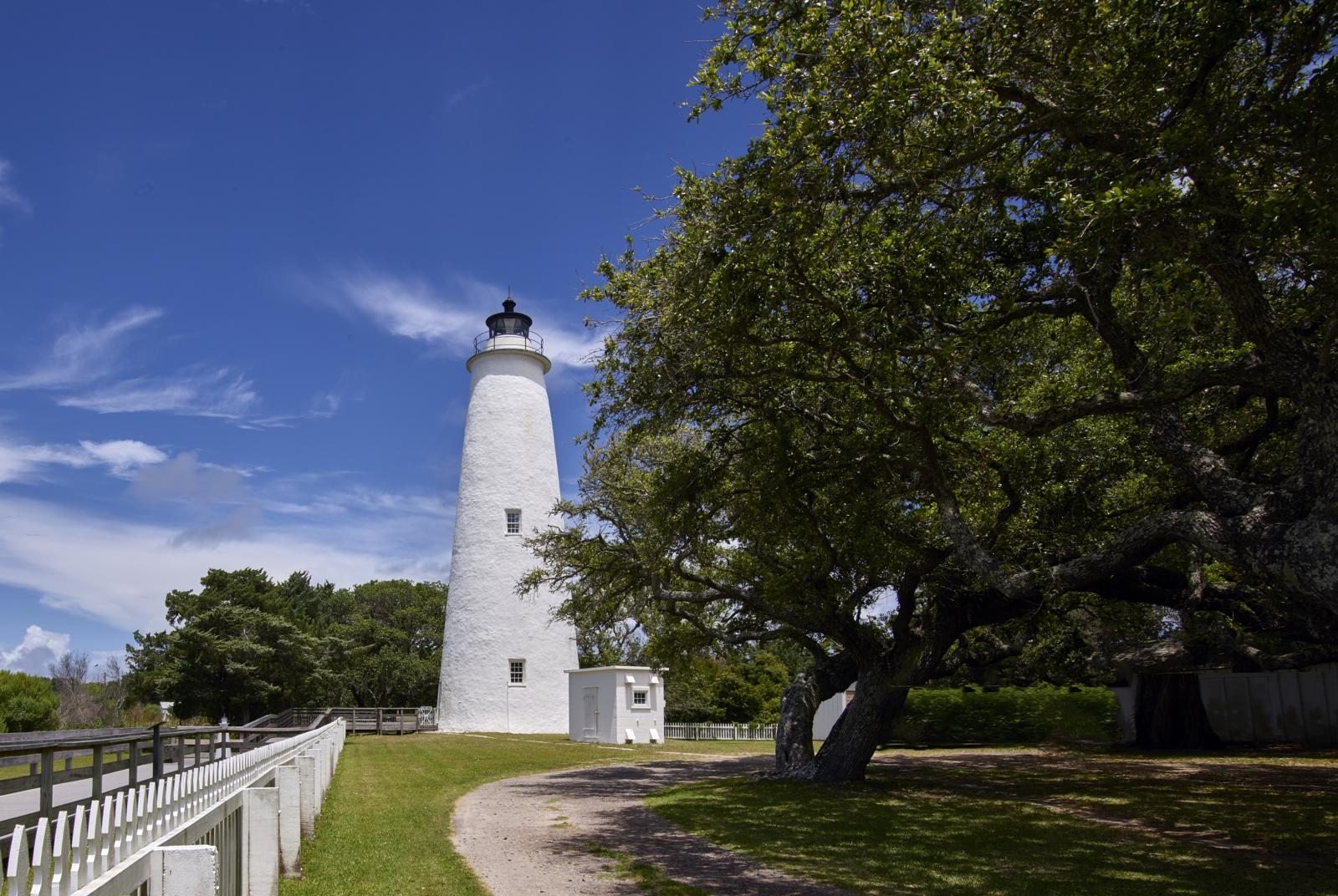
- It isn't whitewashed. The 1823 contract did say "white washed twice over," but in late 1952 the whole tower and its stone foundation were coated in shotcrete — sprayed Portland cement — and painted. That jacket buried a cut-stone foundation that had stood about two feet above ground, and it traps moisture in the brick, which is slowly damaging it. The current restoration plans to strip it back to a breathable coating and re-expose the stone.
- The staircase spirals the wrong way. The original wooden stair is gone — the Park Service's Historic Structures Report ties its removal to the Great Atlantic Hurricane of 1944, while its Cultural Landscape Report says the boards had simply rotted and the stair came out around 1950, after the light was automated. Either way it was replaced by a steel spiral that turns the other direction — so the landings no longer line up with the six windows built to light them. The mortar patches and ghost marks of the old stair are still on the inside wall. Roughly eighty-six steps, then a seven-rung ladder through a hatch. That ladder is why you can't climb it.
- The lantern sits nine inches off-center. The present twelve-panel iron lantern is an 1850s replacement, and the smaller prefabricated unit had to be positioned around the existing masonry floor hatch. Once you know, you can see it.
- The lens may be a lot younger than everyone says. Nearly every source calls it an 1854 fourth-order Fresnel by L. Sautter of Paris. But the Park Service's own 2015 Historic Structures Report records that the brass base is stamped "Barbier et Cie" and dated 1890, and dates the installation to 1899 — while an NPS press release from 2010 calls it "the 1860 Fresnel lens." Three official sources, three dates. It is, either way, a genuine Fresnel lens and still the working optic.
- It was never meant to guide you in. From the Collector's Office at Ocracoke, December 18, 1830: its object "is not to guide vessels into the harbor as no one can enter at night, but to give warning to mariners when off the Inlet." A warning light, not a harbor light.
- The builder nearly went broke over it. The government refused to accept the finished lighthouse and withheld payment — the walls weren't uniformly graduated, the lantern deck was freestone instead of soapstone, the keeper's rooms were plastered straight onto brick, Porter used Carolina pine instead of Georgia pine, and he'd dug a sand pit on federal land and never filled it. He had borrowed to pay for materials and labor. Charles Bulfinch's son acted as his attorney.
What stood here before
Ocracoke Inlet was the front door to North Carolina long before 1823, and it took three tries to light it.
The first was on Shell Castle Island, the shell-and-oyster rock in the middle of the inlet where John Gray Blount and John Wallace ran a warehousing and lightering business. Congress authorized it in 1794; the government bought a quarter acre in 1797; Henry Dearborn of Boston built a 55-foot wooden pyramid shingled with cedar, finished in 1798 though apparently not lit until 1803. It was the first lighthouse on the Outer Banks. By 1814 the channel had moved and left it a mile from the shipping. On August 16, 1818, lightning destroyed the tower and the keeper's dwelling.
Then came a lightship, funded in 1820 and quickly judged inadequate. Then, finally, this tower.
The light on Beacon Island, which people assume came first, came later — authorized 1851, lit December 1852, discontinued in 1859 when new shoals made its range "dangerous rather than helpful." Beacon Island itself has since eroded away. You can see all of them drawn on the old charts in the case file: Shell Castle on the 1808 survey, Beacon Island with a lighthouse symbol on the 1861 Coast Survey chart.
A footnote worth having: the man who built Shell Castle was Henry Dearborn senior. The Henry A. S. Dearborn who signed Noah Porter's Ocracoke contract as collector of customs at Boston was his son. A 1985 Park Service study collapsed the two into one man and credited "Henry S. Dearborn" with building this lighthouse — an error still being copied forty years later.
It has nothing to do with Blackbeard
Blackbeard was killed in Ocracoke Inlet on November 22, 1718. This lighthouse was contracted in June 1823 and lit in August 1824 — a hundred and five years later. In 1718 there was no lighthouse at Ocracoke Inlet of any kind; the first wasn't even authorized until 1794.
No Park Service, Coast Guard or National Register document connects them. The Park Service's Blackbeard page never mentions the lighthouse and its lighthouse pages never mention Blackbeard. They get bundled because Ocracoke has exactly two famous things and they sit two miles apart, and because the tower is the most photographable object on the island, so it ends up illustrating pirate articles by default.
The one real link is the water. Both exist because Ocracoke Inlet is shallow, shifting and dangerous — the same quality that made it a good place to hide a sloop made it a bad place to bring a merchant ship. The Coast Guard still keeps the name in service: "Teaches Hole Lighted Buoy 9" is a numbered federal aid to navigation in the same channel sequence.
If you want the man rather than the tower, that's here, and the ground he died off is Springer's Point, a quarter mile down the road.
Storms
The tower has never been rebuilt, never been moved and has never failed in a storm. It sits on relatively high ground in the village, and it used to be where the island went to wait one out. Villagers rowed boats up flooded roads to reach it and sat out the storm in the keepers' quarters — the Park Service documents an instance in September 1913, for which the keeper was formally commended. (In 1944, the surviving eyewitness account has villagers sheltering in Carlton Kelly's house instead.)
Hurricane Dorian, September 6, 2019, was the worst thing that ever happened to the station: a seven-foot surge off Pamlico Sound — reported locally as two feet above anything previously recorded, though no tide gauge on the island measured it — putting up to two feet of brackish water through the buildings. The superintendent's line was "nothing escaped the flood from Dorian." Congress appropriated $2 million; the contract eventually came in at $3.6 million. The Park Service's own environmental assessment puts about 36 inches of surge at the Store House — enough to shove the building nine feet off its foundation — and records the Oil House submerged. The tower itself came through structurally sound.
Because Cape Hatteras Lighthouse was famously moved in 1999, people asked whether Ocracoke would be moved too. It was never seriously on the table.
The island's full storm record — and why the flooding here comes out of the sound rather than off the beach — is on the hurricane page.
One more: the light went dark in November 2009 for restoration and was relit on March 3, 2010 — the first time it had gone out since the Civil War.
The island is worth more than a photo of the tower
Blackbeard's Gold: The Crossing starts in the ferry line and works the village on foot — the lighthouse, the harbor, the trail to Teach's Hole — with a case file three centuries of diggers never had. $29 per team.
Start the Hunt — $29 per team Pick your crossing$29 per team of up to six, not per person. Your team link arrives by email straight after checkout. Nothing to install.
Common questions
- Can you climb the Ocracoke Lighthouse?
- No, and there has never been a public climb here. The top is reached by a ladder through a hatch. Bodie Island is the one on the Outer Banks you can climb; Cape Hatteras is closed for restoration through 2026.
- Is it open to visitors?
- The grounds, yes, daily and free. The base of the tower opens on limited hours mid-April to October and is closed the rest of the year. Hours depend on staffing — check before you go.
- Where do you park?
- Four spaces plus one accessible space on Lighthouse Road. Walking or biking from Silver Lake takes about ten minutes and removes the problem.
- Is it the second-oldest lighthouse in the United States?
- No. Sandy Hook, Boston Light, Portland Head, Montauk Point and New London Harbor are all older and still lit. It is the oldest still operating in North Carolina, and that part is solid.
- Does it have anything to do with Blackbeard?
- No. He died in 1718; the tower was lit in 1824. There was no lighthouse here in his lifetime at all.
- Is it still a working lighthouse?
- Yes — Light List number 660, fixed white, fifteen nautical miles, still using a Fresnel lens. The Coast Guard runs the light, the Park Service owns the tower.
Sources
Access, climbing, seasonal base hours and the "behind Boston Light and Sandy Hook" correction: National Park Service, Cape Hatteras National Seashore. Parking spaces, boardwalk and no entrance fee: National Park Service. Construction contract of June 20, 1823, Noah Porter, the $10,200 contract and $11,359.35 final cost, the Jacob Gaskill land purchase, the 1952 shotcrete, the 1953 steel stair, the off-center lantern, the Barbier et Cie 1890 lens stamp, and the payment dispute: John Oppermann, Historic Structures Report: Ocracoke Light Station, National Park Service, December 2015. The August 15, 1824 first lighting and Dale Mutro's 2023 discovery of the Pleasonton letter: Island Free Press, and the date as adopted by the National Park Service. The 1830 Collector's Office quotation: Robert Mills, The American Pharos, 1832, via the Historic Structures Report. Light characteristic, range and Light List number 660, and Teaches Hole Lighted Buoy 9: United States Coast Guard Light List, Volume II, 2025. Shell Castle Island, the 1818 lightning strike, the 1820 lightship and the Dearborn attribution error: Louis Torres, Historic Resource Study, Cape Hatteras National Seashore, National Park Service, 1985, read alongside the 2015 Historic Structures Report. Beacon Island light 1852–1859: Lighthouse Friends. Hurricane Dorian damage, the $2 million appropriation and the $3.6 million contract: Coastal Review. Restoration progress through May 2026: Island Free Press and The Outer Banks Voice. Blackbeard's death date and location: National Park Service.