Short answer: no. No hoard of Blackbeard's treasure has ever been found — not in 1718, not since. What exists is the wreck of his flagship and the hundreds of thousands of artifacts pulled off it, held at the North Carolina Maritime Museum in Beaufort. There's gold in that collection. It's dust.
What was actually recovered
In 1996, a private research firm located a wreck off Beaufort Inlet believed to be the Queen Anne's Revenge — the flagship Blackbeard ran aground in June 1718, less than six months before his death. Archaeologists have worked the site ever since, and the haul is real: cannon, anchors, ballast stones, shot, ship's fittings, and hundreds of thousands of individual artifacts, gold dust among them.
Read that list again, though. It's a working warship's inventory, not a pirate's vault. Anything valuable that could walk off that sandbar in 1718 almost certainly did — with the man himself, who had less than six months left to spend it.
The quote that started the digging
The night before Lieutenant Maynard's sloops came into the inlet, Blackbeard's crew asked him whether his wife knew where his money was hidden. Captain Charles Johnson's A General History of the Pyrates, published in 1724, records the answer:
"…that no-body but himself and the Devil, knew where it was, and the longest liver should take all."
He was dead by the next afternoon, and the Devil has kept the secret. That single sentence is the entire documented basis for every treasure dig on this coast since — there is no map, no letter, no second source. One line, delivered to an audience he had every reason to tease.
The holes that never paid
People dug anyway. They still do. The sites with the strongest claims have all come up empty:
- Plum Point, Bath — where he kept a house after taking the King's pardon. Generations of digging around the old foundation have produced arguments and nothing else.
- Teach's Kettle — a brick structure near Bath that legend filled with gold. It was almost certainly a tar kettle, the most ordinary object on that working coast, and a landowner finally tore it down because he was tired of people digging holes around it.
- Archbell Point — Governor Eden's estate, complete with a legend of secret tunnels for the Governor's cut. No tunnel and no cut have ever surfaced.
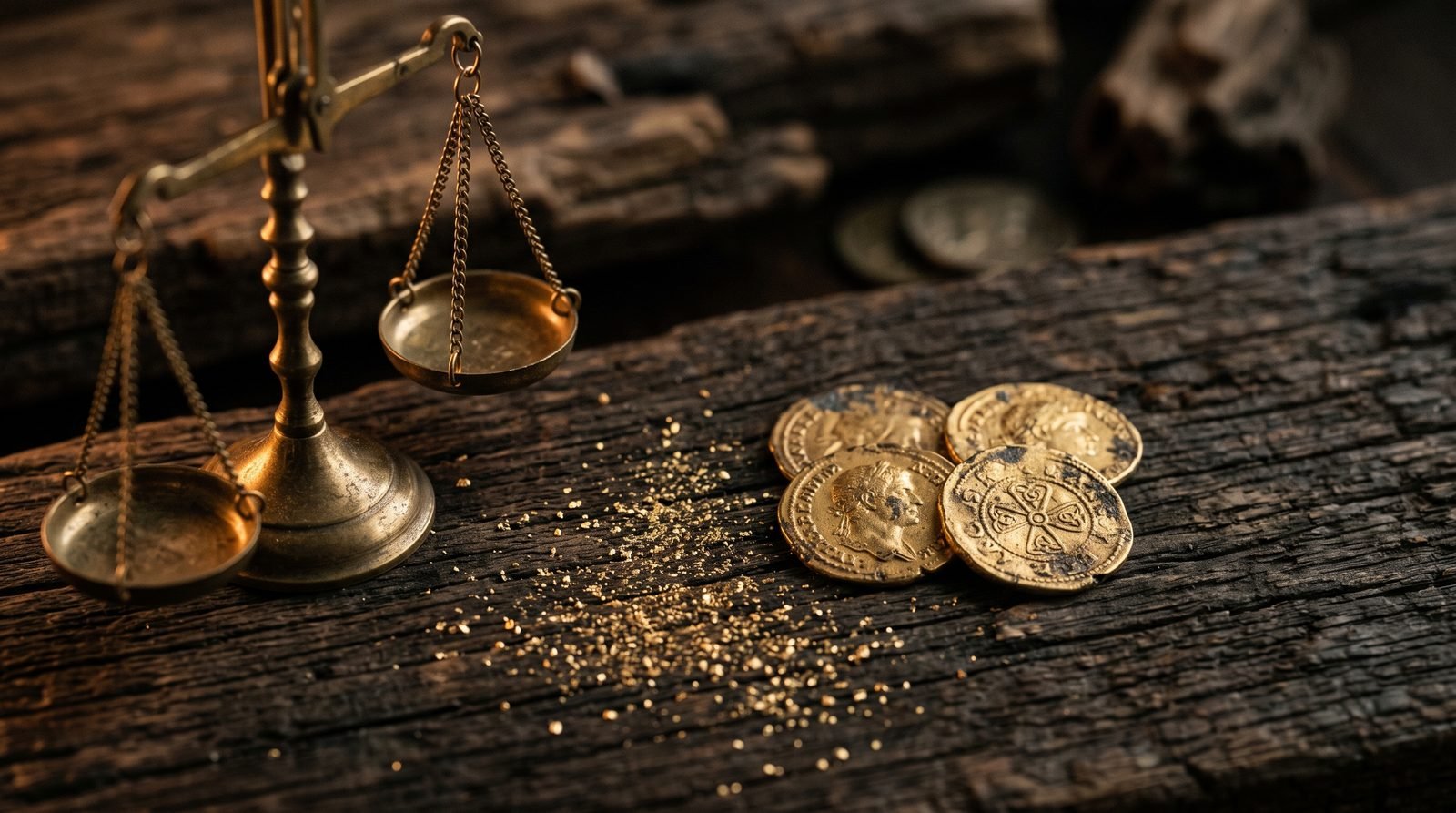
The gold itself was real
Empty holes are an argument against a map with an X on it. They are not an argument against the gold — because actual gold sits in this story's paperwork at three separate points.
Teach learned the trade out of Nassau under Benjamin Hornigold, in the years just after the 1715 Spanish treasure fleet drowned off Florida with its registered silver and gold aboard. Nassau ran on what came off those wrecks. The crews he sailed among raided the Spanish salvage camps themselves — a single raid on the storehouses carried off a reported 350,000 pieces of eight. That was his apprenticeship: an economy of coin, not cargo.
Then came the day in November 1717 when he took the French ship La Concorde — the one he renamed Queen Anne's Revenge. By the surviving deposition of her own lieutenant, a cabin boy named Louis Arot showed the pirates where the gold dust aboard was hidden, and the officers were made to give it up — as much as twenty pounds of it by the accounting that survives, a figure nobody has ever confirmed and nobody has managed to kill. Three centuries later, archaeologists working the wreck at Beaufort Inlet were still picking gold grains and snipped jewelry out of the sediment between the planking.
And between Martinique and Ocracoke lie two years of prizes. The cargo he took was sold and shared out — that part made paperwork. What a captured captain kept in the cabin never made anyone's ledger. The auction after his death listed sugar, cocoa, indigo and cotton: an inventory of what he had not yet sold, not an accounting of what had crossed his deck. On the coin and the dust, the record simply stops.
The case against a chest
Historians who study the period point out the unglamorous truth: pirate plunder was mostly cargo — sugar, cocoa, cloth, indigo — and it was sold and shared out fast, because a crew signed on for wages, not for a savings plan. Burying wealth was almost unheard of; the one pirate reliably documented doing it was William Kidd, and it didn't save him. Blackbeard's fortune, whatever it was, most likely went the way fortunes usually go: spent, divided, and scattered long before Maynard's sloops found him.
Which means the quote was probably a joke at his crew's expense. It also means nobody has ever proven it was.
The ground itself has moved
There is one more problem with “someone would have found it by now,” and it is the ground. The inlet Blackbeard actually sailed is gone: the Hatteras Inlet of his day lay south of the present one and sanded shut around 1764. The channel the ferry crosses today did not exist until a storm cut it on September 7, 1846 — a hundred and twenty-eight years after he died at Ocracoke. Any landmark a man might have used in 1718 to mark a spot sits on a coast that has since redrawn itself.
It has not stopped. The state has flown aerial surveys over Ocracoke since the early 1990s, and thirty years of them read like a stop-motion film: the island’s north tip builds, curls and hooks around the ferry dock, and the shoals trade places between flights. Storms still cut new inlets through these islands — Isabel opened one beside Hatteras village in 2003, Irene opened another through Pea Island in 2011 — and storms still hand things back. Nor’easters routinely strip the beach down to the bones of the G.A. Kohler, a four-masted schooner driven ashore in 1933, burned for her iron during the Second World War, and buried and unburied by the sand ever since.
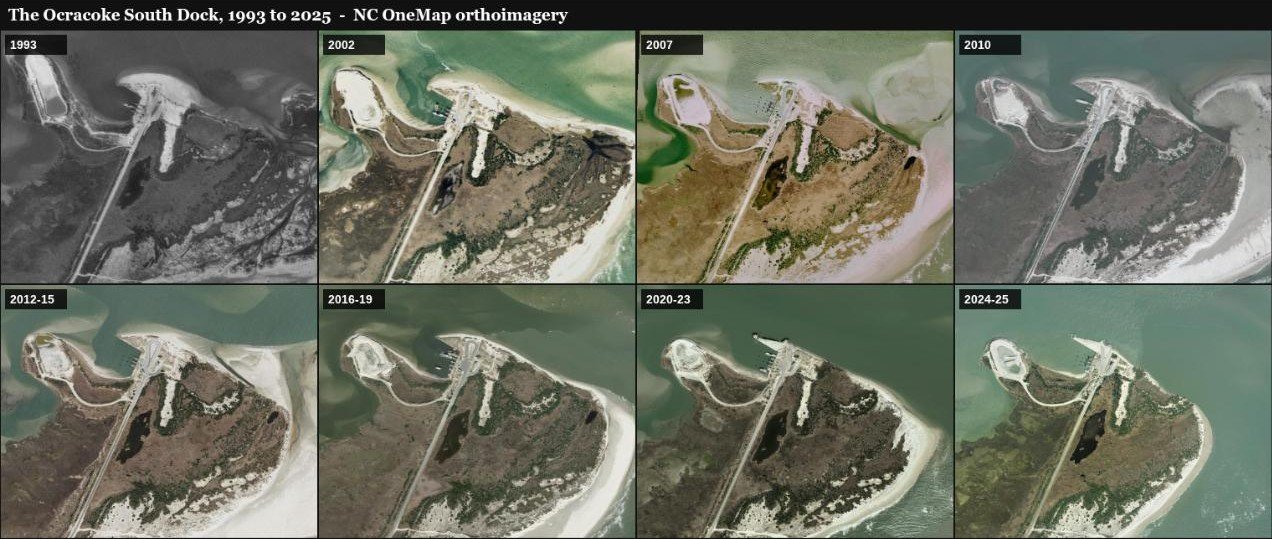
None of that proves a chest. It does mean the strongest argument against one — that three centuries of looking would have turned it up — assumes the ground kept still and let itself be searched. It did not. On this coast, “never found” has mostly meant “not found yet, where somebody happened to look, in the year the sand allowed it.”
So why does everyone look at Ocracoke?
Because it's where the story ends. Ocracoke was his refuge and his last anchorage, and the water he died in — Teach's Hole, on November 22, 1718 — still carries his name. You can stand at the edge of it today at Springer's Point, at the end of a sandy trail through the maritime forest. If he hid anything anywhere, he spent his last weeks here. That's not evidence. It's just why the island has never stopped wondering.
Planning to come look for yourself? Every way onto the island is a ferry, and the rest of Ocracoke earns the trip even if the gold stays lost.
What the island does have, instead of gold, is paper. Four hundred years of surveyors, engravers and naval officers measured this inlet to the foot and not one of them drew an X — the case file collects the sheets, from a 1590 engraving to a 1936 aerial of the village.
The gold is still out there. Hunt it.
Blackbeard's Gold: The Crossing is a self-guided treasure hunt across the real Ocracoke — his harbor, his village trail, and the water where he died. You work a case file three centuries of diggers never had, and every answer is waiting on a sign, a marker or a museum wall. $29 per team.
Start the Hunt — $29 per team See the four versions$29 per team, not per person. Your team link arrives by email straight after checkout. Nothing to install.
Common questions
- Has Blackbeard's treasure ever been found?
- No. In more than three hundred years, no hoard of Blackbeard's treasure has ever been found — not on Ocracoke, not at Bath, not anywhere. The closest archaeology has come is the wreck of his flagship, the Queen Anne's Revenge, which has produced hundreds of thousands of artifacts including gold dust — but no chest and no hoard.
- Where can I see real Blackbeard artifacts?
- The North Carolina Maritime Museum in Beaufort holds the material recovered from the Queen Anne's Revenge wreck site — cannon, ballast, shot, gold dust and hundreds of thousands of other artifacts recovered since the wreck was located in 1996.
- Did Blackbeard bury treasure on Ocracoke?
- There is no evidence he buried anything, on Ocracoke or anywhere else. The night before he was killed, he told his crew that nobody but himself and the Devil knew where his money was hidden — and that is the entire documented record. Ocracoke was his last anchorage, and Teach's Hole, the water where he died, is still there off Springer's Point.
- What treasure was on the Queen Anne's Revenge?
- Working cargo and traces — gold dust among the ballast and fittings, but nothing like a treasure hoard. The ship ran aground in June 1718, less than six months before Blackbeard's death, and anything valuable that could be carried off almost certainly was.